Monochrome Raw Conversion Without Demosaicing
Design, implementation, and a measured comparison against demosaic-based B&W conversion and a true monochrome sensor
by Marco Ristuccia (with a huge help of Claude Fable!)
HBMono v1.0 for macos with Intel or Apple Silicon (click to download)
Abstract
The typical black & white conversion we all do for RAW files produced by Bayer-sensor cameras happens by first demosaicing — interpolating three color values at every photosite — and then discarding the color. This estimates values that were never measured, and for monochrome output the color estimation could be avoided. HBMono is a command-line tool that converts Bayer raw files (developed against Hasselblad .3FR; any LibRaw-supported Bayer format works) directly into monochrome linear DNG files using three interpolation-free strategies: 2×2 super-pixel binning, full-resolution channel equalization, and quincunx re-indexing of the green lattice. This article briefly describes the science behind each strategy and a quantitative comparison of resolution and noise against conventional demosaic-plus-BW-conversion and against a simulated true monochrome sensor.
The headline results: on neutral subjects demosaicing retains more detail than green-only methods (every CFA pixel is a valid luminance sample there), and the equalized-mosaic mode is exact; the quincunx mode delivers about 85 % of demosaiced horizontal/vertical resolution with zero invented pixels; binning matches a monochrome sensor’s per-pixel SNR at half resolution; and a true monochrome sensor retains an unbeatable ~1-stop noise advantage that no CFA processing can recover.
1. Background and motivation
A Bayer color filter array (CFA) samples the scene through a mosaic of red, green, and blue filters — one color per photosite, greens on a checkerboard occupying half the sites (Bayer, 1976). Demosaicing reconstructs the missing two channels per pixel by interpolation, exploiting cross-channel correlation. It is a guess — a well-informed one, but a guess — and its failure modes (zipper artifacts, false color, hallucinated texture beyond Nyquist) survive into a B&W conversion as luminance errors.
For photographers whose target is monochrome, an alternative exists: skip reconstruction entirely and treat the measured photosite values as the image. The closest prior art is Monochrome2DNG (FastRawViewer/LibRaw team), which serves cameras whose CFA has been physically removed; there, every photosite is a valid luminance sample. With the CFA still in place, the core obstacle is that equally-illuminated photosites of different channels record different values — the strategies below are three ways of dealing with exactly that.
The academic framing is luminance estimation directly from CFA data, a sub-problem of demosaicing theory: in the spatial-frequency domain a Bayer image separates into baseband luminance plus chrominance modulated at high frequencies (Alleysson et al., 2005; Dubois, 2005), and the green quincunx lattice has well-studied reconstruction properties. HBMono deliberately uses only the simplest, fully transparent members of this family — nothing the pixel data cannot directly justify.
2. The three strategies and the science behind them
2.1 bin — 2×2 super-pixel binning
Each RGGB quad collapses to one output pixel. Two weightings are provided:
- G weighting (default): — a pure green-channel image. This is the classic B&W green-filter rendering (pleasing skin, lively foliage), using only the two most densely sampled, identically-filtered photosites.
- Luma weighting: where R’ and B’ are equalized to green via white-balance gains and clipped at green’s saturation. All four measured photons contribute; noise is lowest.
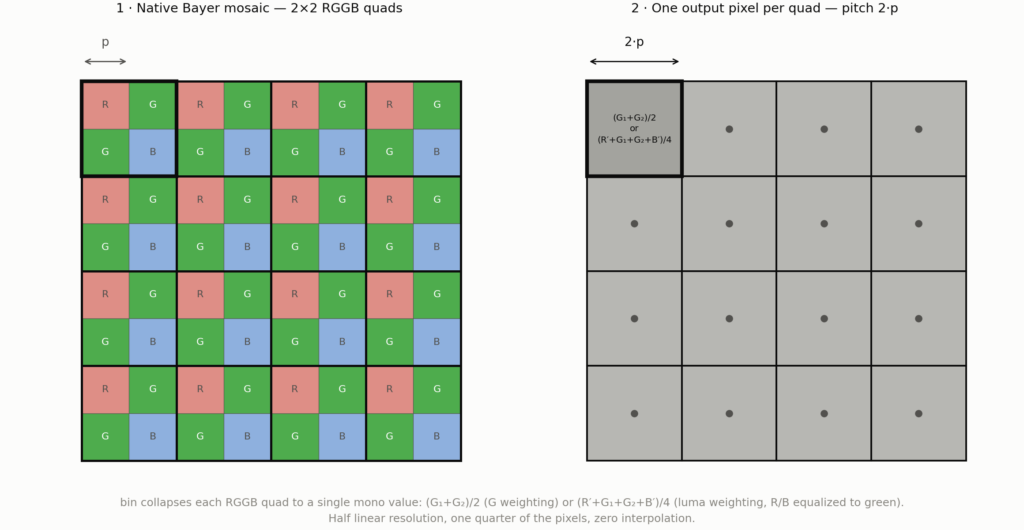
The bin strategy. Left: the native mosaic partitioned into 2×2 RGGB quads. Right: each quad collapses to one monochrome output pixel at twice the native pitch — no value is ever interpolated.
Output is half the linear resolution and a quarter of the pixels; nothing is interpolated. This is the “super-pixel” mode long used in astrophotography stacking. The effective sampling aperture is the 2×2 quad, whose box-filter MTF rolls off smoothly toward the bin Nyquist of 0.25 cycles/native-pixel.
2.2 flat — full-resolution mosaic with channel equalization
Keep every photosite at native position and apply per-channel gains , (from the as-shot white-balance multipliers, or user-supplied) — i.e. white-balance the mosaic itself. For a neutral (gray) subject, an R photosite then reads the same as its G neighbors, and the mosaic is the luminance image at full native resolution: no reconstruction error at all, because there is nothing to reconstruct.
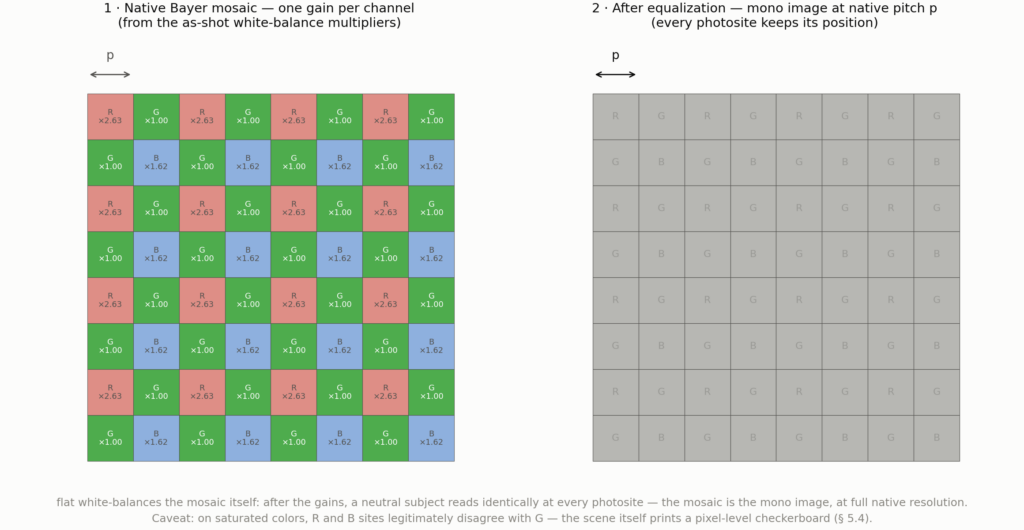
The flat strategy. Left: one gain per CFA channel, from the white-balance multipliers. Right: after equalization a neutral subject reads identically at every photosite — the mosaic itself becomes the monochrome image, still at native pitch.
The catch is scene-dependent: wherever the scene is saturated in color, R and B photosites legitimately disagree with G, and the disagreement renders as a pixel-level checkerboard lattice. No global gain can fix this — it is chrominance aliasing, the same energy a demosaicer routes into its chroma channels. Highlights are protected by clipping all channels at green’s saturation so they clip together.
2.3 quincunx — the green checkerboard as a rotated square grid
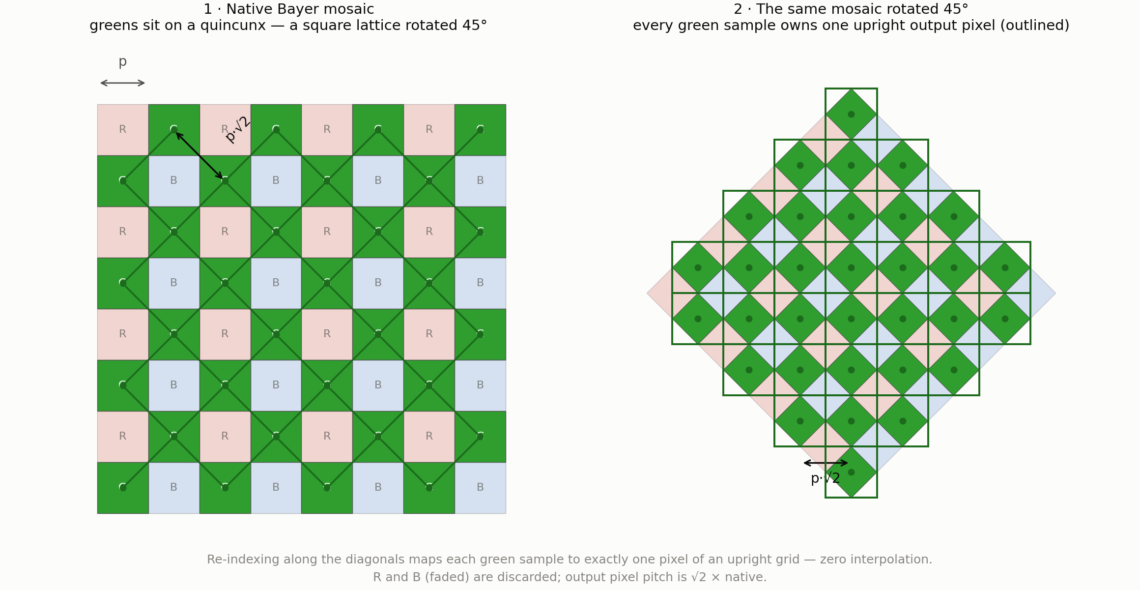
The green photosites form a quincunx (checkerboard) lattice. That lattice is a square grid — rotated 45°, with pitch native pixels. Re-indexing along the diagonal basis , maps every green sample to exactly one pixel of an upright image; the scene content appears rotated 45° inside a diamond. Zero interpolation, zero non-green data — the purest software approximation of a monochrome sensor a Bayer chip can offer.
Sampling theory gives this lattice an interesting anisotropy: its Brillouin zone is the diamond , so horizontal and vertical gratings are supported all the way to the native Nyquist of 0.5 cycles/pixel, while diagonal gratings alias beyond 0.354. Since man-made scenes are dominated by horizontal/vertical structure, the practical cost is lower than the “half the pixels” arithmetic suggests.
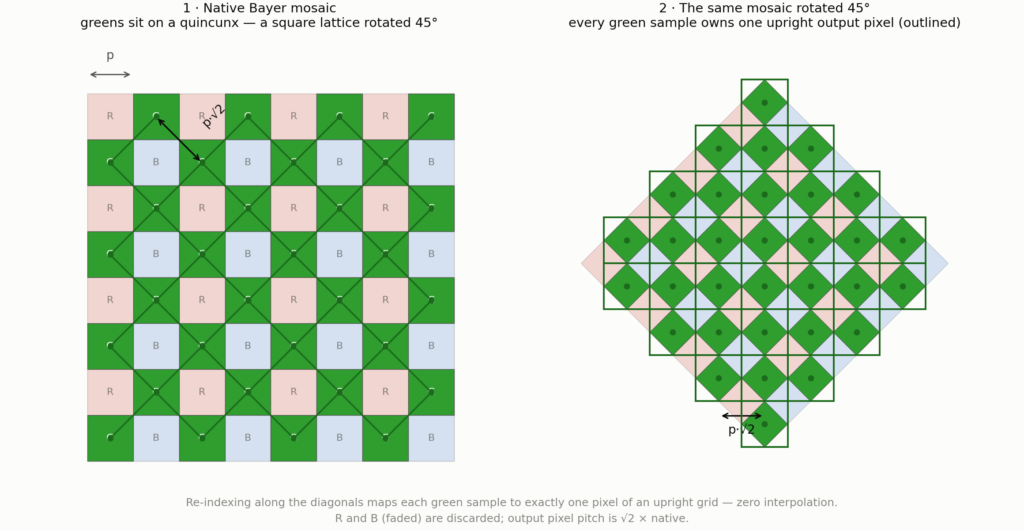
The quincunx re-indexing. Left: the native Bayer mosaic — the green photosites (highlighted) sit on a square lattice rotated 45°, traced by the diagonal lines, with pitch √2·p. Right: the same mosaic rotated 45° — every green sample now owns exactly one pixel of an upright square grid (outlined); red and blue (faded) are discarded.
Two practical additions:
- Gr/Gb equalization. The two greens of each quad can differ slightly (crosstalk from neighboring red vs. blue rows). On the rotated grid they occupy alternating diagonals, so an imbalance renders as a lattice. HBMono measures the global Gr/Gb ratio per file and equalizes it (on the test camera: 1.00283, i.e. 0.28 %).
- –derotate. One bicubic (Catmull-Rom) resample maps the rotated grid back to an upright frame of pixels — the same pixel count as the number of green samples, so no fake resolution is created. This is the single spatial (never chromatic) interpolation a user can opt into; the lattice-faithful mapping preserves the anisotropic frequency support described above.
2.4 What none of these can do
A green-only image is the scene through a green filter, not scene luminance, and a CFA sensor discards roughly half its photons compared to a filterless monochrome sensor. Section 5 quantifies both points.
4. Using HBMono
HBMono is a standalone command-line application that can run on macos. Both Intel and Apple Silicon architectures are supported.
Once you’ve downloaded the archive (link provided at the beginning of this article), unzip it and save it in a folder of your choice. Ideally, you may want to add this folder to your PATH variable in your .bash_profile file so that you can run the archive without having to type the entire path.
$ <hbmono-path>/hbmono

usage: hbmono <bin|flat|quincunx> <input raw> [options]
  -o <file>            output DNG path (default: input name + _<mode>.dng)
  --weights <g|luma>   bin mode: G-only or (R+2G+B)/4 luma (default g)
  --wb <asshot|R,G,B>  channel gains for equalization (default asshot)
  --no-grgb            quincunx: skip Gr/Gb equalization
  --derotate           quincunx: bicubic resample back to an upright frame
  --autocrop           quincunx: tag the largest inscribed rectangle as
                       DefaultCrop (crops away most of the frame)
  --uncompressed       disable lossless JPEG compression
All commands below were run against the reference capture used throughout this paper — a Hasselblad CFV-100c / 907X .3FR (11 904 × 8 842 photosites, 11 664 × 8 750 active, RGGB, ISO 64, f/8, 1/250 s, 203 MB):
| Command | Output | Size | Notes |
| hbmono bin IMG.3FR | 5 832 × 4 375 | 32 MB | green-filter look, zero interpolation |
| hbmono bin IMG.3FR –weights luma | 5 832 × 4 375 | 30 MB | all photons, lowest noise |
| hbmono flat IMG.3FR | 11 664 × 8 750 | 168 MB | native res; neutral scenes only |
| hbmono quincunx IMG.3FR | 10 207 × 10 206 | 91 MB | 45°-rotated diamond, purest mode |
| hbmono quincunx IMG.3FR –derotate | 8 246 × 6 186 | 60 MB | upright, one spatial resample |
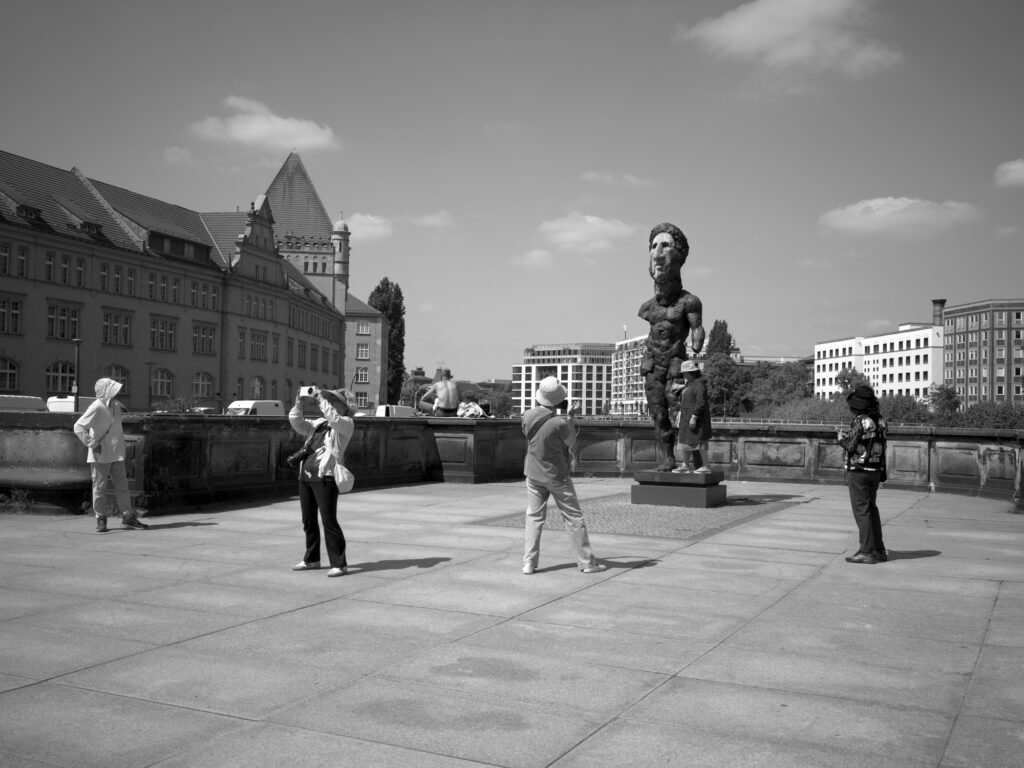
Example conversion: bin mode of the reference capture (Berlin, CFV-100c).
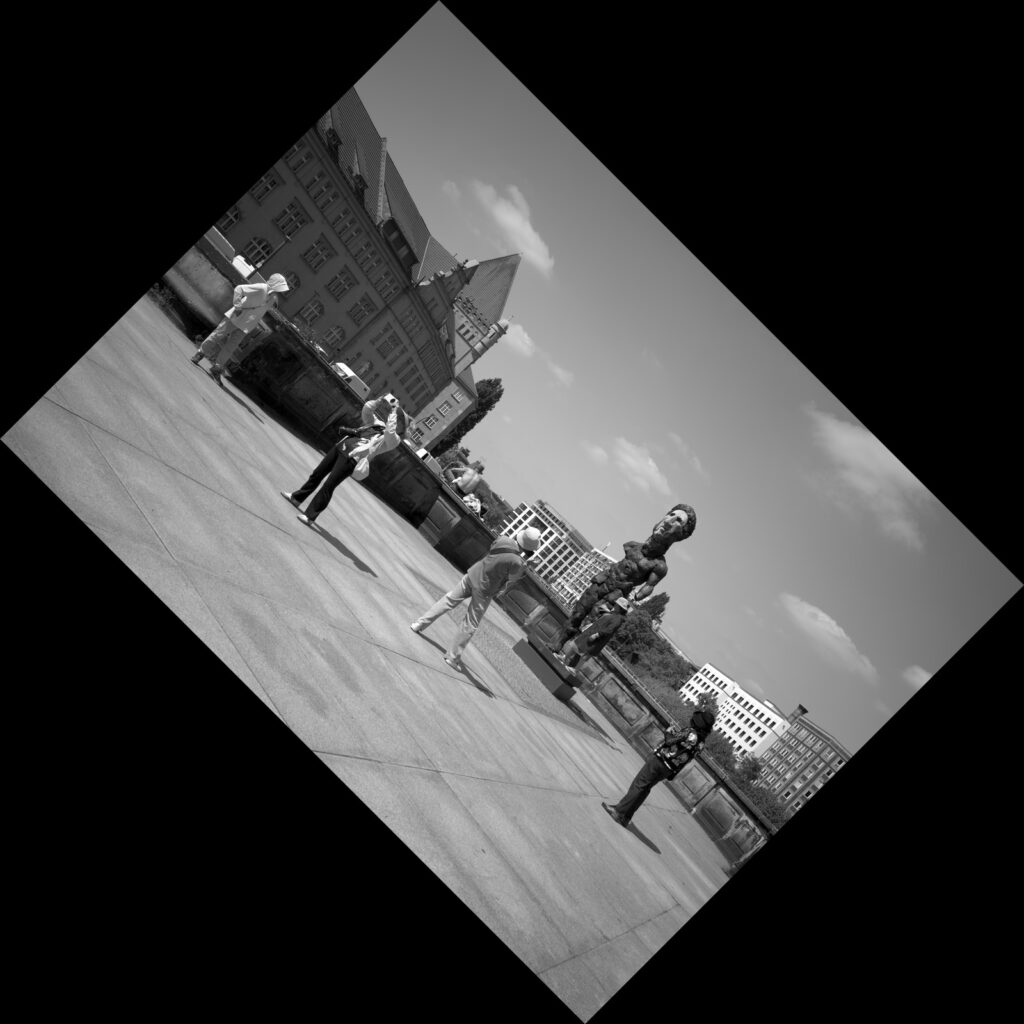
quincunx mode: every green sample mapped, uninterpolated, onto the rotated grid — the diamond framing is inherent to the geometry.
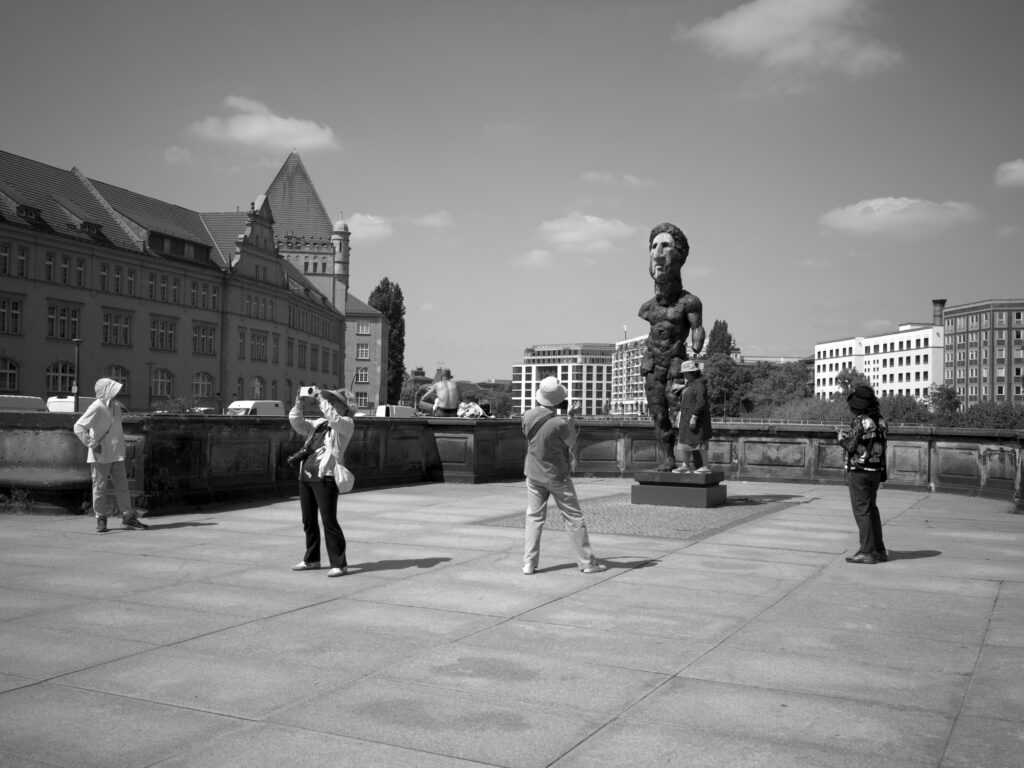
quincunx –derotate: the same data resampled upright (8 246 × 6 186).
5. Measured comparison
5.1 Methodology
Resolution. A synthetic zone plate (all spatial frequencies to beyond Nyquist, all orientations, analytically known ground truth) was rendered as a neutral scene with 2×2-supersampled pixel aperture, mosaicked with Hasselblad-like channel sensitivities (R = 1/2.63, B = 1/1.62 of G), and written as a Bayer DNG. Both pipelines consumed the same file: HBMono’s three modes on one side; LibRaw’s AHD and DHT demosaicers followed by Rec. 709 luma conversion on the other. A simulated monochrome sensor — every native photosite sampling scene luminance directly, no CFA — was added as reference. Because each method’s output-grid-to-scene mapping is known exactly, the retained contrast at each frequency is measured as the least-squares gain of the output against the analytic reference per frequency band (a matched filter: blur lowers it, aliasing junk decorrelates to ~0), normalized at low frequency. The neutral scene is deliberately demosaicing’s best case.
Noise. Uniform patches at 2 %, 18 %, and 50 % of full scale were simulated with Poisson shot noise (50 000 e⁻ full well at G saturation) and 3 e⁻ RMS read noise at identical exposure, mosaicked with the same sensitivities, and pushed through every real pipeline. The monochrome sensor collects the summed pass-bands of the three CFA channels — 2.0× a green photosite’s photons, consistent with the white-balance data and the folklore “about one stop.” SNR (mean/std) is reported per output pixel at each method’s native output scale, and again with every output box-resampled to the bin grid (matched display scale), which credits full-resolution outputs for their downsampling headroom.
5.2 Resolution results
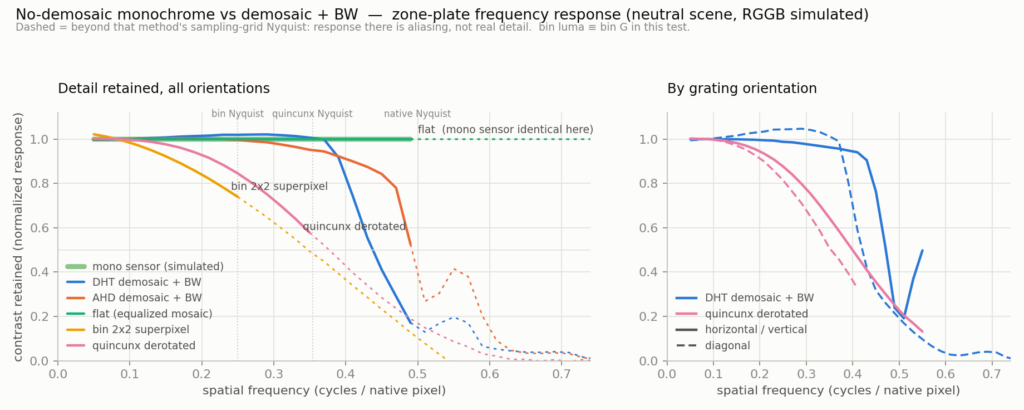
Zone-plate frequency response. Dashed segments lie beyond that method’s sampling-grid Nyquist: response there is aliasing, not real detail.
| Method | MTF50 | MTF10 | MTF50 H/V | MTF50 diag | Grid Nyquist |
| mono sensor (simulated) | exact* | exact* | exact* | exact* | 0.50 |
| AHD demosaic + BW | 0.51 | 0.61 | — | — | 0.50 |
| DHT demosaic + BW | 0.45 | 0.59 | 0.49 | 0.43 | 0.50 |
| flat (equalized mosaic) | exact* | exact* | exact* | exact* | 0.50 |
| quincunx derotated | 0.39 | 0.55 | 0.41 | 0.37 | 0.354–0.50 |
| bin 2×2 (g ≡ luma here) | 0.35 | 0.51 | 0.35 | 0.37 | 0.25 |
Frequencies in cycles/native pixel. “exact*”: response ≈ 1.0 across the measured range — on a neutral scene these methods reproduce the sampled scene with no reconstruction error. For flat this guarantee only holds on neutral content (§ 5.4).
Key observations:
- Demosaicing does not lose luminance detail on neutral subjects. After white balance, every photosite — red, green, and blue — is a valid luminance sample there, and demosaicers exploit it, resolving essentially to the native Nyquist. The response demosaicers show beyond 0.5 (the bump near 0.55) is manufactured false detail: real artifacts, not real information.
- flat is exact on neutral content and identical to the monochrome sensor there — the strongest possible result, with a hard scene-dependence caveat.
- quincunx is orientation-smart: MTF50 of 0.41 horizontal/vertical (85 % of DHT’s 0.49) falling to 0.37 diagonal, exactly as lattice theory predicts. Everything it shows is measured, never invented.
- bin is clean to its Nyquist and degrades gracefully into honest aliasing beyond.
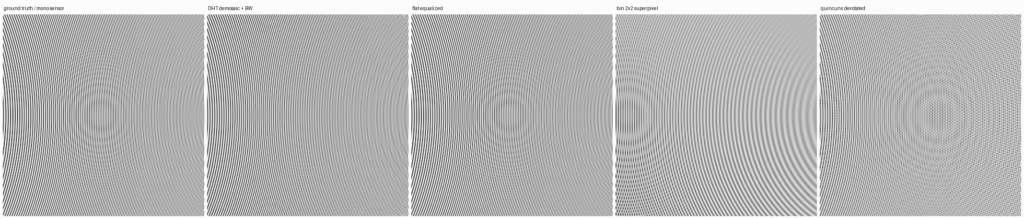
Zone-plate patches around 0.24–0.43 cycles/native pixel (near-vertical gratings). Note the demosaicer’s near-perfect reconstruction on this neutral target, bin’s moiré rings beyond its Nyquist, and quincunx’s clean horizontal axis with diagonal-region moiré.
5.3 Noise results
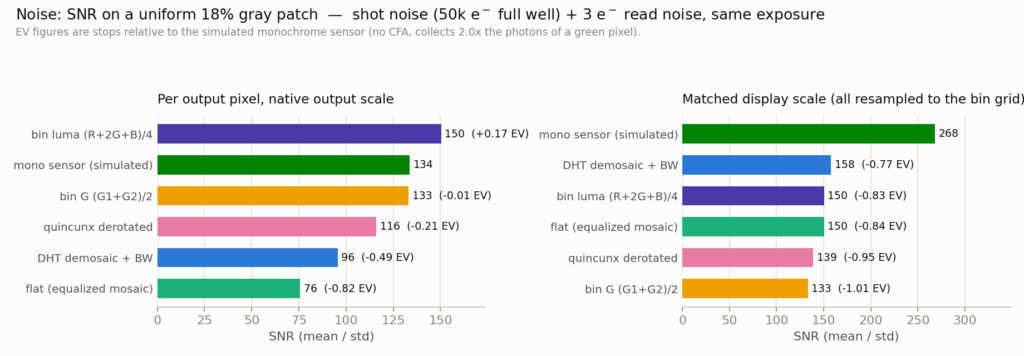
SNR on a uniform 18 % gray patch under identical exposure.
Left: per output pixel at native output scale. Right: all outputs resampled to the bin grid.
| Method | SNR @2 % | SNR @18 % | SNR @50 % | @18 % matched scale |
| mono sensor (simulated) | 44.6 | 133.7 | 223.5 | 268.1 |
| bin luma (R+2G+B)/4 | 50.1 | 150.3 | 253.4 | 150.3 |
| bin G (G1+G2)/2 | 44.4 | 133.2 | 223.9 | 133.2 |
| quincunx derotated | 38.7 | 116.0 | 194.3 | 138.8 |
| DHT demosaic + BW | 31.9 | 95.5 | 159.7 | 157.6 |
| flat (equalized mosaic) | 25.1 | 75.6 | 126.4 | 150.3 |
Reading the table:
- Binning buys back the monochrome sensor’s per-pixel SNR. bin G matches the mono sensor per pixel (133 vs 134) — at half the resolution. bin luma exceeds it slightly by averaging all four photosites.
- At matched display scale the monochrome sensor wins by ~0.8–1.0 EV over everything (268 vs 158 for the best CFA method). This is physics — the CFA discarded the photons — and no processing recovers it.
- flat has the worst per-pixel noise (−0.82 EV vs mono): red photosites are amplified 2.63× by equalization, so noise is both higher and spatially patterned (a gain checkerboard). Downsampled to the bin grid it becomes exactly bin luma (150.3) — the two are the same measurement at different scales.
- Demosaic+BW sits between: interpolation averages neighboring samples, trading its resolution advantage for noise smoothing; at matched scale it is marginally the best CFA option (157.6) because it uses all photons at full grid density.
- Read noise is negligible above 2 % here; at very low signal all CFA methods converge toward the same photon-starved penalty vs. mono.
5.4 Real-image verification (Hasselblad CFV-100c capture)
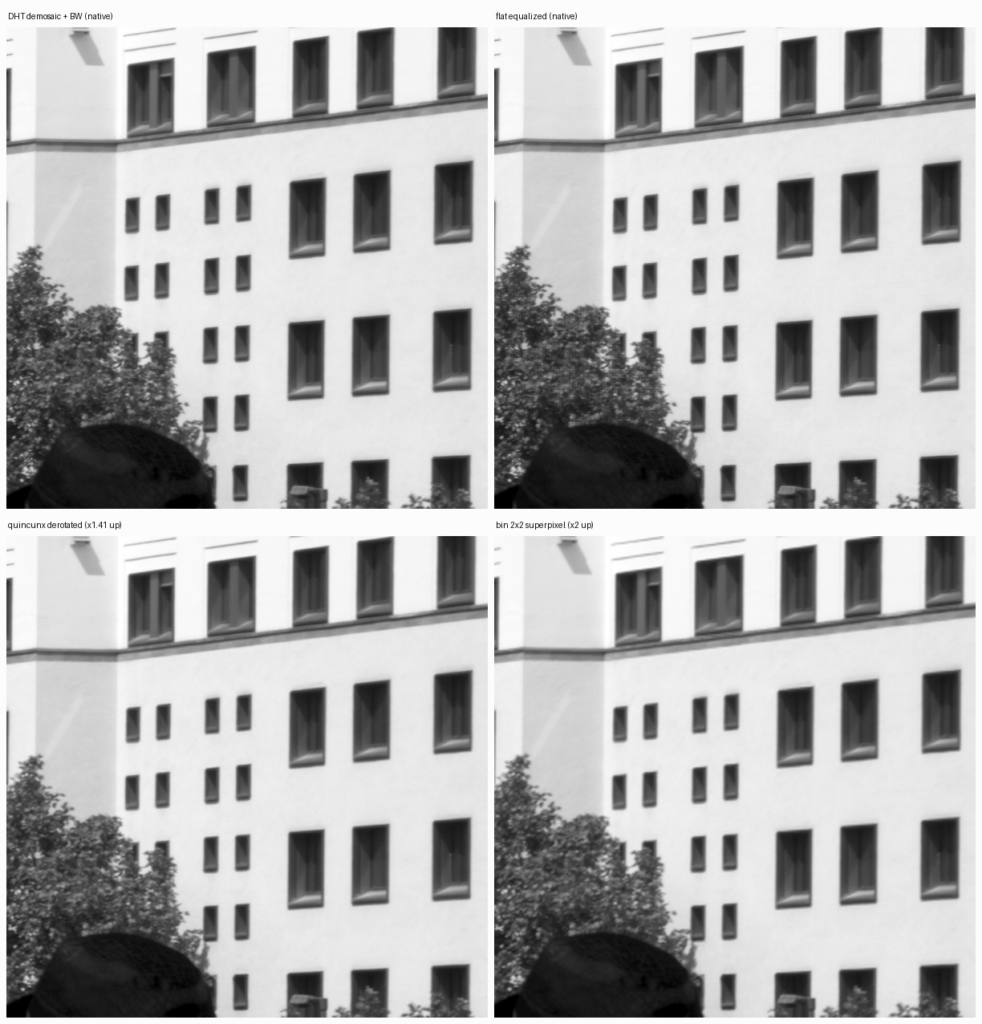
Matched 100 % crops (a common display tone curve is applied to all panels; measurements in this paper always use the linear data). DHT and flat are indistinguishable on the neutral wall; flat shows its chroma checkerboard on the colored foliage and hat; quincunx is close to DHT with slightly softer diagonals; bin is visibly but gracefully softer.
Quantitative spot checks on the same capture: per-CFA-phase means in a neutral gray pavement patch of flat output agree within 3.1 % (the mode works); in saturated blue sky they spread 76.7 % (R = 5 081, G = 7 240, B = 10 923) — the checkerboard below, which no global gain can remove. The measured Gr/Gb imbalance was 1.00283 (0.28 %), corrected automatically in quincunx mode.

Flat output in saturated blue sky at 200 % (nearest-neighbor zoom, contrast-stretched): the scene-induced chroma checkerboard
A note on this test’s scope: the zone-plate study is neutral-only — demosaicing’s best case. On strongly colored high-frequency content, demosaicers additionally hallucinate luminance artifacts from chroma edges after BW conversion, while the green-only modes (bin g, quincunx) are immune by construction; flat degrades as shown above. Section 7 demonstrates and quantifies this on a purpose-built chroma target.
6. Conclusions and recommendations
The honest conclusion first: for general-purpose real-world B&W photography, demosaicing followed by conversion is the rational default, and this project’s own measurements say so. On neutral content demosaic+BW retains more detail than any green-only method (§ 5.2) and flat merely ties it, with a scene-dependent failure mode demosaicing does not have. At matched viewing scale demosaic+BW is also the best-noise CFA option (§ 5.3). Above all, it keeps the color information alive: the classic red/orange/yellow/green filter renderings remain a slider in post, whereas every HBMono mode commits to one spectral rendering — the green-filter look — irreversibly, at conversion time. The project’s founding intuition, that skipping demosaicing preserves more detail, is refuted by our own data for typical scenes.
What survives that concession is specific, and worth stating precisely:
- The filter-in-post flexibility has a hidden asymmetry. A simulated color filter mixes demosaiced estimates. Green-heavy mixes rest on the well-sampled quincunx and are solid; but a strong red-filter mix leans on the R channel — sampled at quarter density, true Nyquist 0.25 cycles/pixel, exactly bin’s — presented at native resolution with interpolation filling the gap, plus the chroma aliasing of § 7. “Any filter at full resolution” overstates what the mosaic measured; the HBMono modes make the same sampling limits explicit instead of hiding them.
- Moiré-prone subjects are a real niche, not a philosophy. Fine textiles, distant brick and signage, halftone print, and LED screens do reach the R/B Nyquist on a 100 MP AA-filterless sensor. In a color image, chroma moiré is visible as color and treatable; after a B&W conversion it is indistinguishable from scene texture and unremovable. § 7 measures the effect and § 7.1 shows where it lives in real content. For large B&W prints of such subjects, bin G or quincunx is a remedy demosaicing cannot offer.
- Archival economics. A capture already committed to monochrome and to the green rendering keeps a 30 MB bin DNG instead of a 203 MB raw — still linear, still with highlight headroom, openable anywhere. That “already committed” is doing real work, and it is the honest boundary of the use case.
- Measurement-grade imaging. Where pixel values must be measurements rather than estimates (astronomical stacking, reprography, technical documentation), super-pixel binning is standard practice for exactly the guarantees HBMono provides.
Within those niches the recommendations stand: bin G as the default (bulletproof, monochrome-sensor per-pixel SNR, quarter-size files, chroma-immune), quincunx –derotate when resolution matters (~85 % of demosaiced H/V resolution, zero chromatic guessing), bin luma only for scenes without high-frequency color (§ 7), and flat as an expert option for low-saturation scenes. A true monochrome back retains a ~1-stop noise advantage at matched viewing scale that no CFA processing — HBMono‘s or a demosaicer — can recover. That is physics, not software.
7. Addendum: chroma-induced luminance hallucination
Section 5 measured demosaicing at its best — neutral content, where cross-channel correlation holds perfectly. This addendum constructs the opposite case and shows what each pipeline does with it.
Test scene. Vertical red↔blue stripes whose frequency is chirped from 0.03 to 0.50 cycles/pixel left to right — shown below in color as the camera would see it. The green channel is strictly constant, and R + B is constant (the stripes swap red for blue, never brightness in the sum). The true Rec. 709 luminance therefore carries only a small real ripple (~9 % of its mean, from the different R and B luma weights) at every frequency — the analytic ground truth in the top strip of the B&W panel. Crucially, red and blue photosites each sample the scene at a pitch of 2 pixels, so their Nyquist limit is 0.25 cycles/pixel: beyond it, no pipeline can measure the stripes from R/B data — it can only guess, alias, or ignore.

The test scene in color: red↔blue stripes at constant summed brightness, frequency rising left to right. Everything below is a B&W rendering of this pattern.
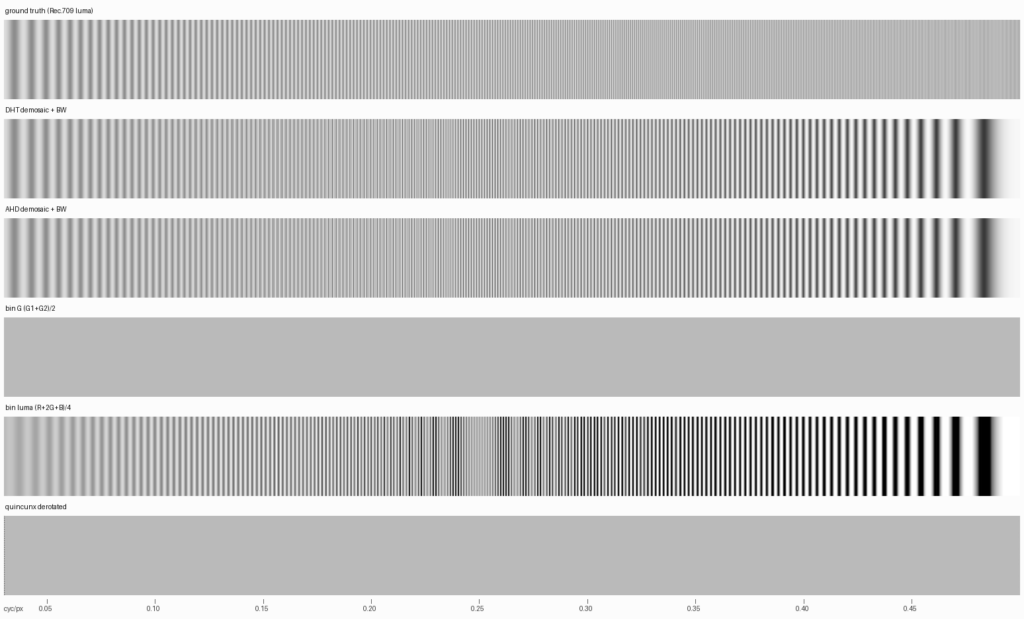
Chroma stripe chirp (frequency increases left to right; each panel normalized to its own mean, common display mapping). Demosaicers reproduce the ripple correctly at low frequency, then beyond ≈0.3 cyc/px render bold, wide bands at entirely wrong frequencies and roughly double the true amplitude. bin G and quincunx render the chroma-only pattern flat, as a green filter sees it. bin luma aliases hardest — its R/B quarter-samples fold the pattern down with only a box filter to protect them.
Measured ripple amplitude (std of the detrended horizontal profile, % of each output’s mean):
| Pipeline | f = 0.05–0.20 (measurable) | f = 0.30–0.45 (beyond R/B Nyquist) |
| ground truth (Rec. 709 luma) | 8.9 % | 9.0 % |
| DHT demosaic + BW | 8.2 % | 15.3 % |
| AHD demosaic + BW | 8.2 % | 15.3 % |
| bin G (G1+G2)/2 | 0.0 % | 0.0 % |
| bin luma (R+2G+B)/4 | 12.5 % | 28.6 % |
| quincunx derotated | 0.0 % | 0.0 % |
Three distinct behaviors emerge:
- Demosaicers hallucinate. Below 0.25 cyc/px both AHD and DHT track the true ripple (8.2 % vs 8.9 %). Beyond it they render ~1.9× their own correct level and ~1.7× the truth — and, worse than the amplitude, the structure is wrong: the panel shows broad, high-contrast bands at frequencies the scene does not contain. In a real photograph (fine textiles, distant colored signage, foliage against sky) this is luminance detail that was never there, permanently baked into a B&W conversion.
- Green-only modes are immune by construction. bin G and quincunx render the chroma-only pattern as a uniform field (0.0 %) — exactly what a green-filtered monochrome capture of this scene would record. This is a rendering stance, not a free lunch: real luminance variation that happens to hide in R/B alone is rendered flat too. It is, however, never false detail.
- bin luma inherits the CFA’s chroma aliasing — amplified. Its R and B quarter-density samples fold high-frequency chroma straight into the output with only the 2×2 box average as protection: 28.6 % ripple in the aliased band, the worst of all pipelines tested, and visible in the panel as hard dark banding. Its low-band figure (12.5 %) is not an error — it is the legitimate ripple of its own equal-weight BW mix — but the high band is pure aliasing.
The practical guidance follows directly: on subjects with fine saturated-color detail, prefer bin G or quincunx over both bin luma and demosaic-based conversion; reserve bin luma’s noise advantage (§ 5.3) for scenes without high-frequency chroma. This sharpens, rather than changes, the recommendations of § 6.
7.1 Where this lives in real photographs
The chirp target isolates the mechanism; this subsection asks how much of it survives in ordinary photographic content. To get a real-world test with known ground truth, the demosaiced Berlin capture was box-downsampled 3× — at the new scale it is simply a fully known RGB scene (any demosaic residue in it becomes legitimate scene content) — then re-mosaicked with the same channel sensitivities and pushed through every pipeline again.
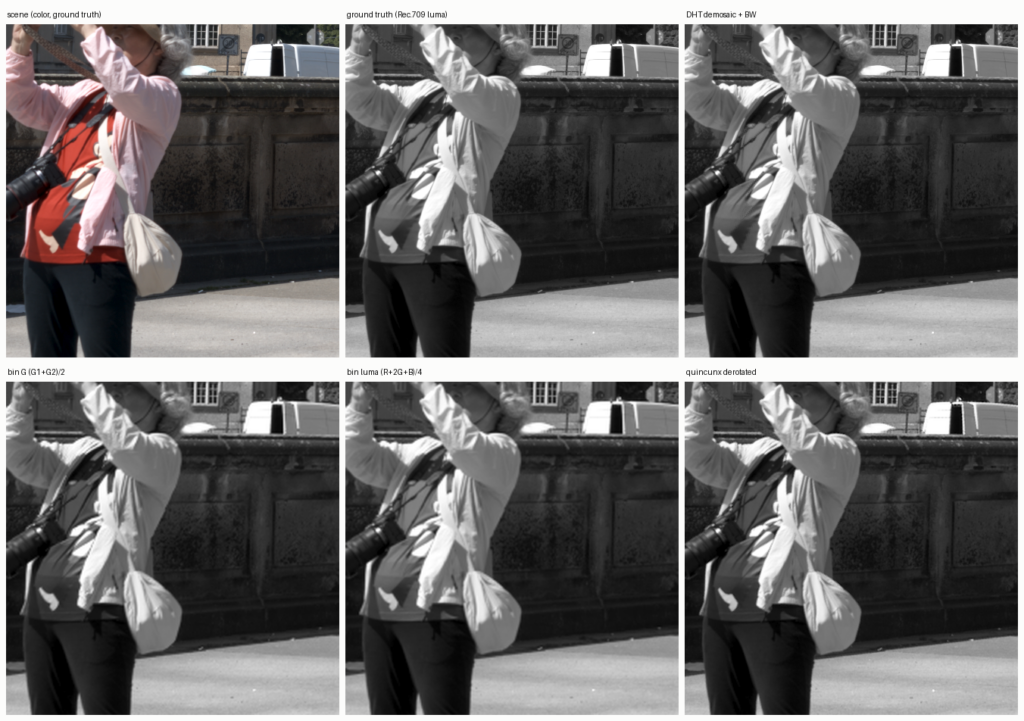
Real-world reconstruction test. Top left: the color scene (known ground truth). The remaining panels are the B&W renderings. Note the red shirt: the luma pipelines render it mid-gray, the green-only modes render it distinctly darker — the green-filter rendering stance made visible, and a concrete illustration of the irreversibility discussed in § 6.
Measured against each pipeline’s own target rendering (Rec. 709 luma for the luma pipelines, the green channel for bin G and quincunx), normalized RMS errors on this scene are small and comparable: DHT 1.9 %, bin G 1.9 %, bin luma 1.7 %, quincunx 2.6 %. That is an honest and important negative result: on ordinary content, even with saturated colors present, demosaicing’s errors are modest — most photographs simply do not put chroma at the sampling limit, which is exactly why demosaic+BW is a good general default (§ 6). Note the figures are not directly rankable across the two target renderings; they describe each method’s fidelity to its own goal.
The nature of the errors, not their magnitude, is what separates the pipelines. Zooming into the region where the errors concentrate — fine foliage behind a parapet — and mapping each output’s deviation from its target:
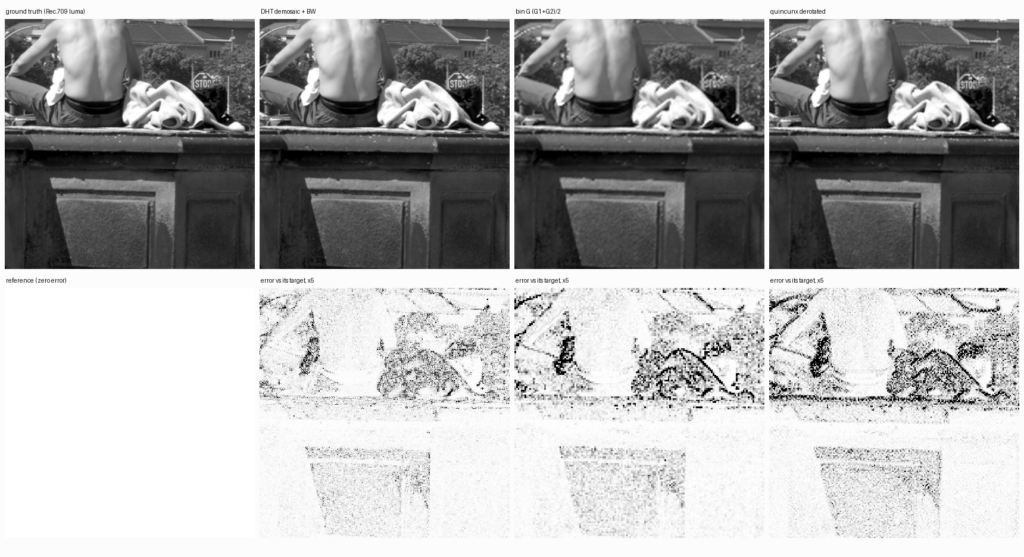
Zoom into the highest-error region, with per-method error maps (darker = larger deviation, amplified 5×). DHT’s errors are structured false texture concentrated in the fine colored foliage — small-scale luminance invented from chroma. The no-demosaic modes’ errors concentrate at high-contrast edges and are pure softening — resolution honestly lost, never detail invented.
This is the practical summary of the whole section: demosaicing errs by inventing, no-demosaic errs by blurring, and on typical content both err little. Subjects that push chroma toward the sampling limit — where the invention becomes visible and permanent in B&W — include fine textiles and knits (houndstooth, tweed), distant colored signage and traffic markings, brick and roof-tile courses, printed halftones, LED/LCD screens, feathers, and backlit foliage edges. Photographers of such subjects are the audience for whom bin G and quincunx exist.
References
- B. E. Bayer, “Color imaging array,” U.S. Patent 3,971,065 (1976).
- D. Alleysson, S. Süsstrunk, J. Hérault, “Linear demosaicing inspired by the human visual system,” IEEE Trans. Image Processing 14(4), 2005.
- E. Dubois, “Frequency-domain methods for demosaicking of Bayer-sampled color images,” IEEE Signal Processing Letters 12(12), 2005.
- ITU-T Recommendation T.81 (JPEG), Annex H (lossless processes) and Annex K (Huffman table generation), 1992.
- Adobe Systems, Digital Negative (DNG) Specification, version 1.4.
- LibRaw LLC, LibRaw raw decoding library; Monochrome2DNG converter, FastRawViewer.
