
Berlin, 2022
Stereotype: a widely held but fixed and oversimplified image or idea of a particular type of person or thing. [Oxford Languages / Google]
A globalized hyper-connected world is said to give plenty of opportunities to exchange ideas and expand one’s vision. Well, in principle that’s true, but in practice this rarely happens, as very few people are able to critically filter and elaborate the huge amount of information available in such wide context and develop a personal point of view.
Instead, for most, the practical result is a smearing of thinking that leads to a standardization of concepts. All different facets of major matters are lost. The endless repetitions of similar standpoints coming from the multitude of individuals are averaged. Thus, complex issues get oversimplified, they turn into slogans.
Such thing can also be seen in the way people look like in terms of dresses, hair cuts and social behavior. International fashion and marketing businesses rely more and more on this effect.
Yet this is a way of depicting what the oneness of humanity is nowadays: a common mainstream aesthetics and mind, which represents all and no one at the same time. On one side, that has the advantage of allowing a powerful sharing and amplification of what we feel are the most important challenges the humanity need to address. On the other side, an impoverishment of the dialectic debate arises, and this may lead to over-simplified solutions, or even to extreme polarizations with deviations towards populism.
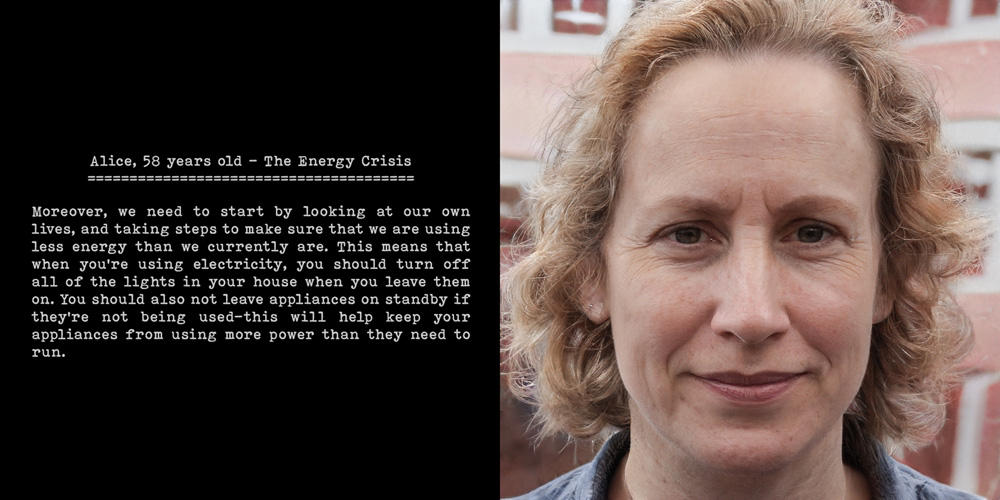
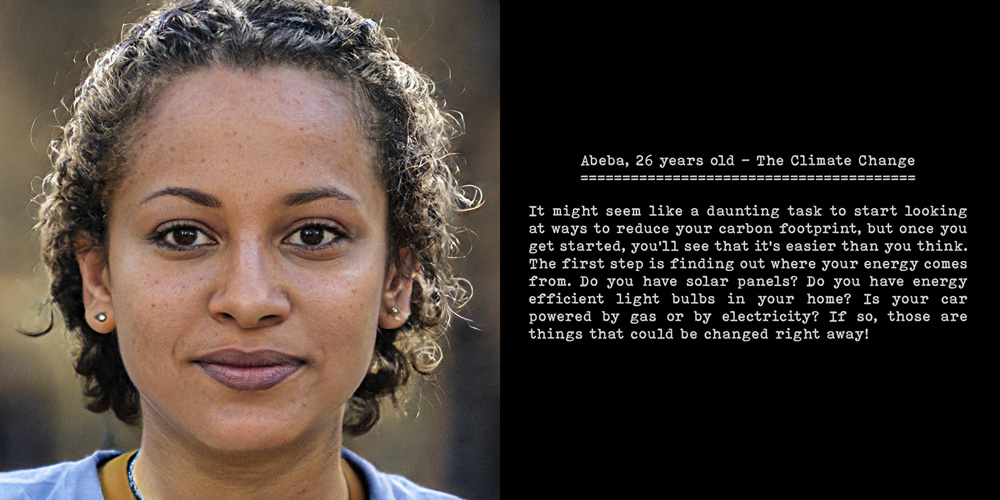
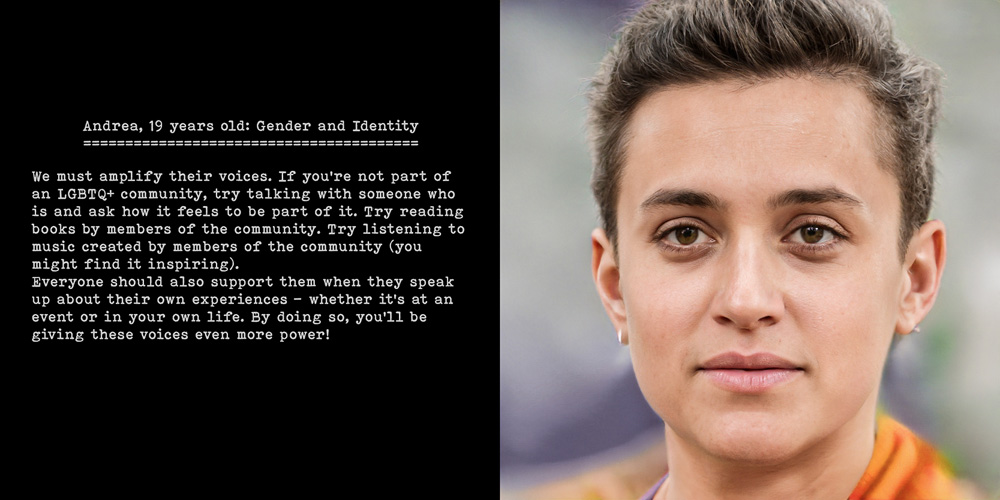
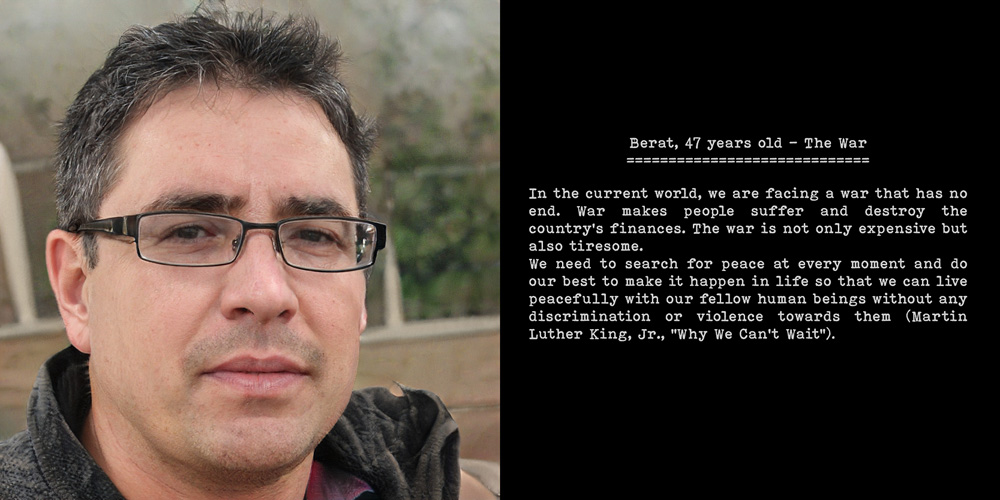
In this project, which lies in-between photography and computer imagery, I’m experimenting with artificial intelligence in order to generate a set of stereotyped individuals, together with their stereotyped standpoints on important world’s contemporary matters. No person nor statement represented here ever existed in reality. They are all synthesized by the AI as a result of learning iterations upon a huge training set composed by portraits and statements of real persons.
The AI training process with its synthesized results perfectly simulate the development and social effects described above.